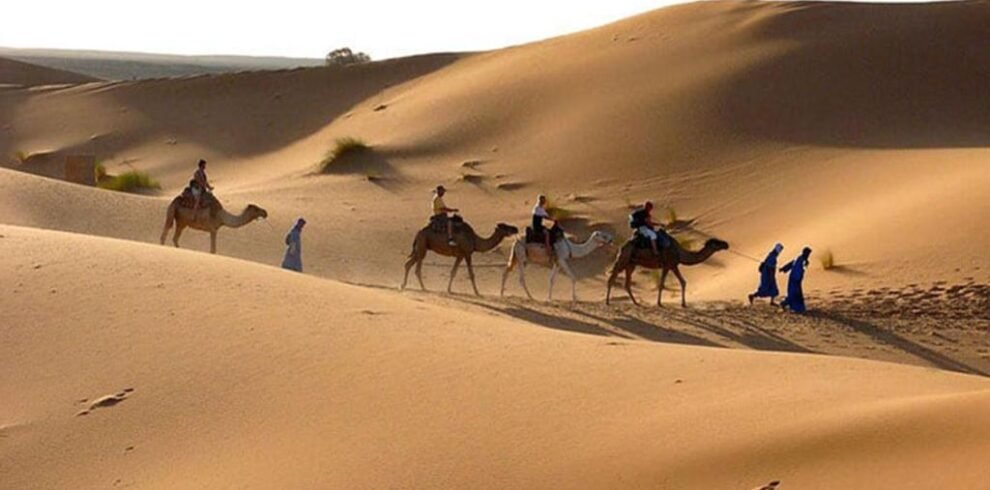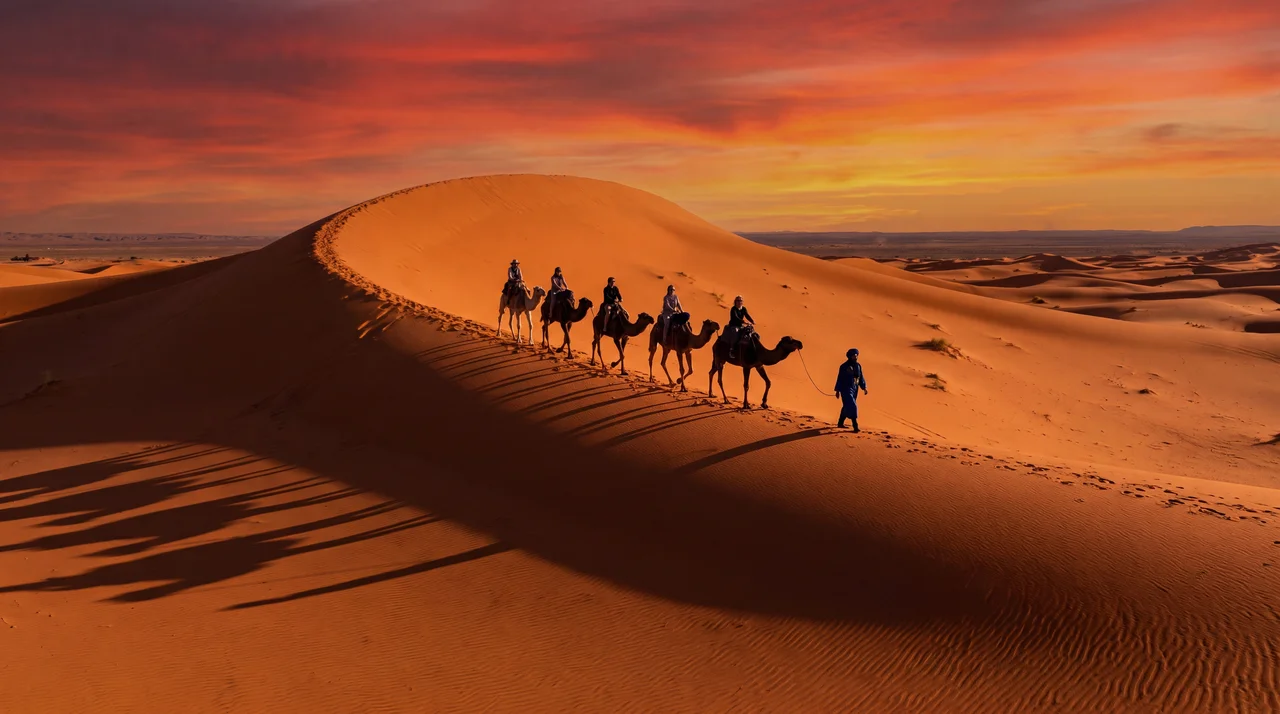
💡 Direct Answer: Camel riding Morocco options range from a short Palmeraie ride near Marrakech to a multi-day Sahara camel trek with overnight desert camp. The most popular option is a sunset camel trek at Merzouga’s Erg Chebbi dunes (included in most 3-day tours). Camel riding in Morocco is generally considered safe and ethical when booked through a reputable operator — key warning signs to avoid are covered in detail below. Weight limit is approximately 100kg (220 lbs) for most operators.
📋 CAMEL RIDING MOROCCO — TABLE OF CONTENTS
- What Camel Riding in Morocco Is Really Like
- Where to Ride a Camel in Morocco (5-Region Comparison)
- How Much Does Camel Riding Cost in Morocco 2026?
- Is Camel Riding in Morocco Ethical?
- Safety, Weight Limits & Who Can Ride
- What to Wear and Bring
- Best Time of Year and Time of Day to Ride
- How to Book Your Camel Ride
- FAQ — 12 Most Asked Questions
- Book a Camel Ride in Morocco
What Camel Riding Morocco Is Really Like
Nobody tells you about the lurch. When your camel stands up — back legs first, then front — you pitch violently forward, then backward, then level out. First-timers almost always grab the saddle horn with both hands. By the second or third ride, you anticipate it and barely notice. That first lurch is one of Morocco’s most reliably memorable moments.
Once upright and moving, camel riding in Morocco settles into a rhythm that is genuinely unlike any other mode of transport. The gait is a slow, swaying walk — not particularly fast (camels average 5–6 km/h) but surprisingly comfortable once your hips relax into the movement. The saddle sits high: you are 2–2.5 meters above the ground, looking across the dune crests or palm groves from a height that changes the view entirely.
The single most important camel riding Morocco tip every experienced rider gives: don’t grip with your knees. Trying to hold yourself rigid against the sway is what causes inner-thigh soreness. Relax, let your hips follow the camel’s movement, and a 45-minute camel ride in Morocco will leave you feeling fine. A 2-hour ride without relaxing will leave you walking uncomfortably for the next day.
Camel Riding Morocco — Mounting and Dismounting
Your camel kneels to let you mount — approach from the left side, put your left foot in the stirrup or foothold, swing your right leg over, and hold on. The guide will instruct the camel to stand, and that’s the lurch moment described above. Dismounting is the same sequence reversed. Most guides in Morocco are experienced and will steady the camel’s head during mounting to prevent unexpected standing.
Is Camel Riding Morocco Uncomfortable?
For camel riding Morocco under 1 hour: genuinely comfortable for most people. For rides of 2–4 hours: expect inner-thigh and lower-back fatigue, particularly if you have a pre-existing back condition. For multi-day treks: camels are best understood as transport to reach a destination (the dune camp), not as a comfortable multi-hour activity — most multi-day desert tours use 4×4 vehicles for the main journey and camels for the atmospheric 30–60 minute approach to the camp.
Camel Riding Morocco — Where to Ride: 5-Region Comparison
This is the most complete region-by-region camel riding Morocco comparison available — covering all five main areas, not just the two most popular ones:
| Region | Distance from Marrakech | Landscape | Cost Level | Trip Length | Best For |
|---|---|---|---|---|---|
| 🏜️ Merzouga (Erg Chebbi) | 558 km / 9–10h | Towering dunes up to 150m — iconic Sahara | Higher (3-day tour) | 3–4 days | Photographers, first-time Sahara visitors, couples |
| 🌴 Zagora / Erg Chigaga | 370–470 km / 6–8h | Draa Valley palms + remote dunes at M’Hamid | Moderate–Higher | 2–4 days | Budget travelers, families, solitude seekers |
| 🪨 Agafay Desert | 35 km / 40 min | Rocky plateau — no sand dunes, Atlas backdrop | Lower–Moderate | 1–2 hours | Quick desert fix, half-day trips, sunset dinners |
| 🌿 Marrakech Palmeraie | 8 km / 15 min | Palm grove — no dunes, urban oasis setting | Lowest | 30–60 min | First-timers, families, travelers without time for the desert |
| 🌊 Agadir / Essaouira | 240–350 km / 3–4h | Atlantic coastal dunes and beach settings | Lower | 30–90 min | Coastal travelers, beach holiday extension |
How Much Does Camel Riding Cost in Morocco in 2026?
Pricing depends heavily on which region and which package you choose. Here’s an honest comparison across all main options:
| Option | Duration | Cost Level | What’s Included |
|---|---|---|---|
| Short Palmeraie ride (Marrakech) | 30–45 min | Lowest cost | Camel ride only, guide on foot |
| Agafay Desert camel trek | 1–1.5 hours | Lower cost | Camel trek, mint tea, transport from Marrakech |
| Sunset camel trek Zagora | 45–60 min | Included in 2-day tour | Part of full tour: transport, camp night, breakfast |
| Sunset camel trek Merzouga (standalone) | 1–1.5 hours | Moderate cost | Sunset dune climb + guide only |
| Merzouga overnight camel bivouac | Evening + sunrise | Moderate–Higher cost | Camel, bivouac tent, dinner, breakfast, sunrise ride |
| 3-day private tour incl. camel trek | 3 days / 2 nights | Highest cost | Full route + hotel + desert camp + camel trek |
Is Camel Riding Morocco Ethical?
The honest answer is: camel riding in Morocco exists on a spectrum, and the ethics depend almost entirely on the operator you choose — not the activity itself.
Camel Riding Morocco — The Case For: Working Animals Built for This
Dromedary camels used for camel riding Morocco experiences are domesticated working animals that have carried loads and riders across the Sahara for over 3,000 years. Unlike horses, which were bred for speed and have fragile legs, camels evolved specifically for long-distance desert travel under load. Their padded feet, fat-storing hump, and multi-chambered stomach are adaptations for exactly this kind of sustained work. A well-treated camel carrying a tourist for 45 minutes is not being mistreated — it is doing what dromedary camels have done for millennia.
Camel Riding Morocco — The Case For Concern: Operator Standards Vary
The problem is not the activity — it is the conditions in which some operators keep their animals. Signs of poor camel welfare include: saddle sores or open wounds on the animal’s back, ribs visibly prominent through the coat (severe underfeeding), constant forced trotting or running (stresses joints), metal nose rings pulled tightly during guidance, and animals kept in direct sun without shade or water during the middle of the day.
How to Choose a Responsible Camel Riding Operator in Morocco
| ✅ Green Flags (Book With Confidence) | ❌ Red Flags (Look Elsewhere) |
|---|---|
| Camels have visible body condition — not too thin | Ribs clearly visible, dull coat, lethargy |
| Well-padded saddle with no visible saddle sores | Bald patches, open sores, or wounds on the back |
| Water available to camels between rides | Animals tied up in full sun with no shade or water |
| Operator limits rides in peak afternoon heat | Riding scheduled 11am–3pm in July/August |
| Guide walks calmly beside the camel | Repeated striking, yanking nose ring aggressively |
The World Animal Protection organization recommends booking animal experiences through established tour operators with verifiable reviews rather than independent street vendors — advice that applies directly to camel riding in Morocco. Operators connected to established camp and tour businesses have reputational incentive to maintain animal welfare standards; individual vendors at tourist sites do not.
Our camel riding Morocco position: We only work with Merzouga and Agafay camel operators we have personally vetted. If you have concerns about a specific operator, ask us directly — we will tell you honestly what we know.
Safety, Weight Limits & Who Can Ride
Weight Limit for Camel Riding in Morocco
The standard weight limit for camel riding in Morocco is approximately 100 kg (220 lbs). Some operators extend this to 110 kg (240 lbs) for shorter, flat-terrain rides. This limit exists to protect both the animal’s spine and the rider’s safety — above this weight, the camel’s gait becomes uneven and the saddle may slip. If you are close to the limit, contact your operator in advance to confirm their specific policy rather than discovering this on the day.
Can You Ride a Camel While Pregnant?
Most camel riding operators in Morocco advise against riding during pregnancy, particularly in the second and third trimesters. The lurching motion of mounting and dismounting, combined with the swaying gait, creates jarring movements that are not recommended during pregnancy. If you are in the first trimester and your doctor has cleared you for normal activity, a very short flat-terrain ride may be acceptable — but always confirm with your operator and consult your physician first.
Can You Ride with Back or Joint Problems?
For chronic lower back conditions, herniated discs, or recent joint surgery: camel riding in Morocco is not recommended without medical clearance. The saddle position places your spine in a lordotic (arched) position, and the swaying gait creates repeated lateral movement. Short rides on flat terrain (Palmeraie, Agafay) are significantly less stressful than dune climbs at Merzouga. If you have a back condition, discuss the specific terrain with your operator before booking.
Can Children Ride Camels in Morocco?
Yes. Most camel riding Morocco operators welcome children from approximately age 5 upward. Children between 5–10 typically ride sharing a saddle with a parent, or on their own camel with the guide walking very closely alongside. Younger children can often sit in front of a parent. Children generally love camel riding — the height and novelty make it one of the most memorable moments of a Morocco family trip.
Is Camel Riding Morocco Safe?
Yes, for most healthy adults and children. Camels are not prone to bolting (unlike horses), move slowly, and are guided on foot by experienced handlers. Falling from a camel is uncommon when the animal is well-managed. The main risks are: the mounting/dismounting lurch (solved by holding on firmly), saddle-related soreness on long rides (solved by relaxing your body), and sunburn (solved by sun protection). Camel riding in Morocco has an excellent safety record when conducted by licensed tour operators.
Camel Riding Morocco — What to Wear and Bring
👗 Clothing
- ☐ Long trousers — essential. Shorts cause inner-thigh friction against the saddle
- ☐ Closed-toe shoes — sandals can slip out of stirrups
- ☐ Light long-sleeve top — sun protection, modesty, warmth at dusk
- ☐ Scarf or headscarf — wind and sand protection, plus respectful in Berber camps
- ☐ Warm layer for desert evenings — temperatures drop rapidly after sunset
🎒 What to Bring
- ☐ Sunscreen SPF 50+ — reapply before mounting
- ☐ Sunglasses — dust and direct sun at altitude
- ☐ 1L water minimum — dehydration accelerates in desert heat
- ☐ Camera with neck strap — not a wrist strap (mounting lurch risk)
- ☐ Small day bag — leave large luggage in vehicle
- ☐ Lip balm — dry desert air is harsh on lips
❌ What NOT to Bring on the Camel
Fragile electronics without protection, handbag with exposed strap (will catch and fall), high heels or platform sandals, anything loose that will blow away (the desert wind is constant).
Best Time of Year for Camel Riding Morocco
Best Months
| Month | Desert Temp (Day) | Desert Temp (Night) | Verdict for Camel Riding |
|---|---|---|---|
| Jan–Feb | 18–20°C | 2–4°C | ✅ Good — cool and clear, bring warm layers for sunset rides |
| Mar–May | 25–33°C | 8–16°C | ⭐ Best months — warm, golden light, comfortable at all hours |
| Jun | 38°C | 22°C | ⚠️ Hot — sunset rides only (5pm+), avoid midday completely |
| Jul–Aug | 44°C+ | 25°C+ | ❌ Avoid — extreme heat dangerous for both riders and animals |
| Sep | 36–38°C | 20°C | ⚠️ Improving — sunset rides only from mid-September |
| Oct–Nov | 24–30°C | 8–14°C | ⭐ Excellent — perfect conditions, stunning light |
| Dec | 16–18°C | 2–4°C | ✅ Good — cold nights but beautiful clear days |
Sunrise vs Sunset — Which is Better?
🌅 Sunrise Camel Ride
- Cooler temperatures — ideal in summer
- Soft pink and orange light on the dunes
- Fewer other riders on the dune crests
- Requires a 5:30am wake-up
- Milky Way still visible leaving camp
🌇 Sunset Camel Ride
- Deep amber and crimson light — more dramatic
- Most popular — peak activity time
- Warmer — comfortable even in cooler months
- More photogenic silhouette compositions
- Returns to camp for evening dinner and fire
How to Book Camel Riding Morocco
FAQ — Camel Riding Morocco 2026: 12 Most Asked Questions
Book Camel Riding Morocco — All Options
Book Palmeraie Ride →
Book Agafay Trek →
Book Merzouga Tour →
📖 Related Guides
Questions about camel riding Morocco? Contact us → — we’ll help you choose the right option for your group, dates, and budget. Response within 24 hours.